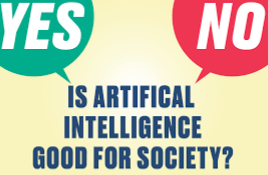
Robots will never take over the world. Plain and simple. Humans could never design technology that complex is what people say. However, it’s already started. Physicist Stephen Hawking said this could “spell the end of the human race” (Kiddle.co). So what is this mystery superintelligent being? Artificial Intelligence, or AI, for short. AI has been used and evolving since about 1950 A.C. Back then, it was only used to solve complex mathematical problems and play chess, and even just these processes were considered very complex at the time. And the truth is, it was and still is. AI is very complex because while it has many positive effects, there are also many conflicting views and challenges as AI evolves, which makes AI very complex.
The first concept that shows how AI has made an impact is the positive effects that it has made and will continue to make in society. One of these effects may be seen in the economy. According to “Gen-AI: Artificial Intelligence and the Future of Work”, “Artificial Intelligence (AI) has the potential to reshape the global economy, especially in the realm of labor markets” (International Monetary Fund). This means that AI can change the way that economies around the world, particularly in the job market. AI can reform the economy around the world and also help in the area of work for so many people, showing that it can be very helpful to society. If AI helps reshape the economy, it can open up more jobs for struggling families. Another example of the positive impact of AI is stated in the following by Britannica School, “These include, among others, medical diagnosis, voice or facial recognition,” (Britannica School). This means that AI can help to find diseases, and identify people’s voices or faces. This proves that AI can help diagnose medical issues and diseases that humans may not be able to detect. It can also help to enhance security systems by using facial recognition, fingerprinting, and even voice recognition. In addition, AI could save lives. 27,000 people around the world die of cancer each day, not to mention the countless number of people who die from other diseases like stroke and assorted dementias. If AI can help diagnose diseases, it can save millions of lives every day. In conclusion, AI has made many positive impacts globally, such as diagnosing cancer, as well as improving security systems, and will continue to save lives, as well as make the lives of many people better.
The next concept that shows how AI has made an impact is the many conflicting views between experts. Many feel differently about the impacts of AI. In fact, as stated earlier, physicist Stephen Hawking said “this could ‘spell the end of the human race’”(Kiddle.co). This means that Hawking said that AI could be catastrophic to life on Earth. Many scientists argue about similar worries. Arguing can cause health problems, especially when they go unresolved. Furthermore, Kiddle.co also states that “Stephen Hawking, Microsoft founder Bill Gates, historian Yuval Noah Harari, and SpaceX founder Elon Musk have all shared serious worries about the future of AI. Mark Zuckerberg (CEO of Facebook) has said that artificial intelligence is helpful now and will continue to assist humans”(Kiddle.co). Many experts are concerned about AI, while others think that AI can be helpful. In other words, while many experts believe that AI can be dangerous, some also believe that it could be helpful. This means that many people have different beliefs as to whether or not AI is good for society. As a result, many civilians are not sure what to think of AI. In summary, many experts have conflicting beliefs as to whether or not AI is helpful or harmful. AI can be useful, but it may also bring some negative effects.
The final concept that proves AI has made an impact is the challenges as AI evolves. Specifically, according to Britannica School,“Since the mid-20th century, computers have been programmed to carry out very complex tasks, such as playing chess and solving mathematical problems” (Britannica School). AI has evolved greatly since about 1950 A.C. So much, in fact, that many scientists believe that one day they may not be able to control it. This means that AI may be dangerous because it has evolved so much. This presents a challenge to scientists to learn how to mitigate AI’s dangers. Additionally, according to experts, “Scientists and engineers had to feed them tons of information, teach them how to understand language, and make them better over time. It’s estimated over 300 BILLION words from Wikipedia, dictionaries, encyclopedias, and books from all over the Internet were used to build ChatGPTs knowledge”(Bedtime History). This means that AI is very hard to maintain, and it gets harder over time. This shows that as AI evolves, it becomes more and more challenging to maintain its credibility. It has become very hard to tell if scientists will be able to control it as it continues to develop. In conclusion, AI has not just ‘spawned’ out of nowhere. It has developed over time and has been a challenge to maintain to the point where experts worry that they won’t be able to control it.
All in all, Artificial Intelligence is very intricate because while it has many helpful outcomes, there are also a good deal of different opinions and obstacles as AI develops. AI has made various beneficial impacts worldwide and will continue to improve and save the lives of many people. A lot of specialists have different opinions as to whether or not AI is good or bad. AI has not just appeared out of the blue. It has changed over time and has been a challenge to keep AI from getting too powerful. Hopefully, in the future, AI can be impactful in more ways than one. Scientists are already hoping it will revolutionize healthcare, scientific discovery, and solve global challenges. So what do you think AI should be used for?
Works Cited
“Artificial intelligence Facts for Kids.” Kids encyclopedia facts, 17 October 2025, https://kids.kiddle.co/Artificial_intelligence. Accessed 8 January 2026.
Bedtime History. “History of AI ChatBots for Kids.” Bedtime History, Bedtime History, https://bedtimehistorystories.com/history-of-ai-chatbots-for-kids/.
Encyclopedia Britannica. “artificial intelligence (AI).” Britannica School, school.eb.com/levels/middle/article/artificial-intelligence/272968.
“Gen-AI: Artificial Intelligence and the Future of Work.” International Monetary Fund, 14 January 2024, https://www.imf.org/en/publications/staff-discussion-notes/issues/2024/01/14/gen-ai-artificial-intelligence-and-the-future-of-work-542379. Accessed 8 January 2026.