Do you know how NIL works in college sports? Or how players get extra years of playing sports in college? NIL, or “name, image, and likeness” is taking over collegiate sports. Basically, NIL allows college athletes to be paid from endorsements, being featured in advertisements, and generally making money off of their fame as athletes. But how does it affect teams’ performance and how are players even getting extra eligibility? Here is how NIL affects college athletes’ extra years to play and how the game has changed.
To start, the way college athletes can play extra years of college sports can be very confusing. Every college athlete is granted four eligibility years for every sport, regardless of age. However, recently, some athletes are getting five, or even six years! This loophole exists through the transfer portal, where players can leave one school to go to another. If you transfer once and/or graduate after four years you can get one more year if you do not use your redshirt year (where you sit out and learn). So now there is one more year players can use.
The NIL and transfer portal started in 2021, so some players had only three out of their four years. If players are currently seniors, they played from 2021 to 2025. Their freshmen year wasn’t eligible because the rule was passed in the summer of 2021, so these players demanded one more year once they graduate – making it six years. One example of this was Ole Miss quarterback Trinidad Chambliss. Chambliss played the first four years of his collegiate career at division two school Ferris State. He then transferred to Ole Miss because he had graduated. He played very well for the Rebels, but when the season ended, he insisted he was not leaving. He claimed that he should have a sixth year to play because in the other five, he didn’t have nearly as many NIL opportunities. This may have been true, but he also gained valuable experience and skills. A 23-year-old playing an 18-year-old in a sport seems very unfair. To close, that is how extra years can give players more time to hone their skills, not only giving them more potential NIL opportunities, but also making them older, more experienced, and stronger than other four-year college athletes.
NIL is also used as an incentive for star players to be paid to attend certain colleges. The most well-known example is Texas University quarterback Arch Manning, who signed in 2022 with an estimated $7 million for going to Texas! The schools pay them to come and play for the season, most likely with additional perks. Schools can get paid millions for winning the national championship or bowl games. It has turned the sport into a monopoly of players only going to certain schools because of a paycheck.
College athletes are also eligible to be paid by brands to be in ads or wear their product. This is negative because the athletes may put more effort into the brand endorsements than their athletic skill set. They may not even want to enter the professional drafts for their sports because they could get more endorsements in colleges. This results in these athletes, again, staying for extra years in college, making it unfair.
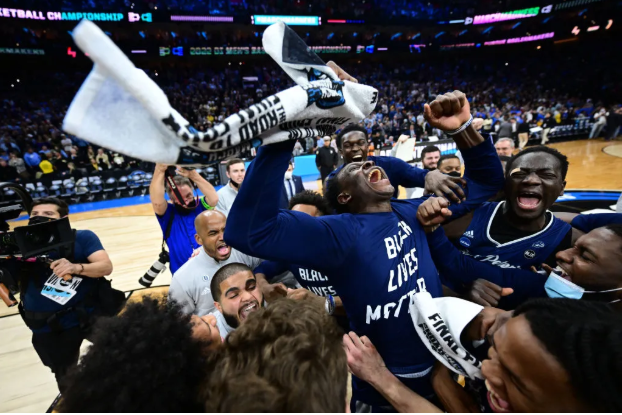
So how are paid players affecting the game? An example would be the March Madness college basketball tournament. March Madness used to usually have a couple cinderellas, which are these small colleges that somehow upset a big school and are going on a run. But, the transfer portal and NIL have hurt that too. If there is some little spark on a team, he or she will usually transfer to a bigger school for a couple thousand dollars, leaving his team behind. The small schools used to have teams that played together for years, giving them a chance to compete with the “Blue Blood” schools during the tournament, but loyalty is almost non-existent in today’s college game. The number one overall picks in the last year and this year were Fernendo Mendoza and Cam Ward and were both transfers in college. They cashed in and played their final seasons at different schools.
The real winners of the NIL is any school with very successful alumni who like sports. A well-known example is Mark Cuban, an Indiana graduate. Last year, Indiana, which isn’t known for its football program, had its best season ever, winning the National Championship. This got the school a massive amount of prize money. It also happened to be the school that Cuban funded the NIL money the most, providing the funds to spend on new recruits and transfers.
While the effects on money in college sports has some minor benefits, like the athletes play longer while getting stronger, teams without as many NIL opportunities can’t keep their star players. It seems that more often than not, the NIL has a complicated, if not completely negative, effect. It was originally intended to let amateur athletes make endorsement money, but now, it’s just schools paying the best players to attend and play, giving some athletes a better advantage than others.
In conclusion, NIL has an impact on every aspect of college athletics. While loyalty is abolished, players get money and extra eligibility. NIL is changing the sport and teams’ performance. Is it right or wrong? What do you think?
Work Cited
Jaillet, Danny. “Travis Hunter’s epic response to Drake Maye and Patriots question.” patriots wire, USA TODAY Sports, 2024, https://patriotswire.usatoday.com/story/sports/nfl/patriots/2024/12/12/travis-hunter-epic-response-drake-maye-patriots-question/76954164007/. Accessed 6 5 2026.