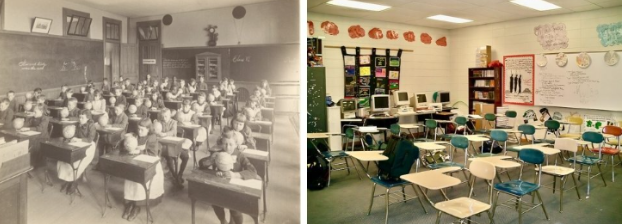
Imagine a day in school where there isn’t a Smart Board at the front of your class, there are no computers, no AI helpers like Grammarly or Canva, and no homework online. Instead, in the 1920s, there were chalkboards, binders, and workbooks that were the main way to complete classwork. Half of your friends wouldn’t have been with you a century ago because of segregation and racism. There are pros and cons to all of these differences in how school looks and works. Which is better, though?
Modern-Day Education
To start, there are several positive aspects to our current schooling system. It offers more options and programs, which provide more equal opportunities for students. Another advantage of the current system is that students are more active during the school day, whereas students 100 years ago spent most of their time in class listening to lectures. The last benefit of the current system is the mix of cultures in one classroom. Kids are learning to value and understand different cultures and backgrounds.
Now for the disadvantages. One is the cost of lunch and breakfast in certain states that don’t have enough funding. The quality of the food also varies depending on where you live. Another negative is that some schools cost a fair amount of money, whereas others don’t. Sometimes, schools that cost more money don’t have a wide variety of cultures and backgrounds. The last drawback of the current system is that students might feel like the work is either too easy or too hard, and teachers don’t notice. As a result, some students fall behind and don’t catch up, while others are always ahead and never feel challenged or satisfied. These systems are improving, though, and many schools have been implementing honors programs and challenging extracurricular activities.
Education 100 Years Ago:
There are really no simple pros and cons, but have you ever wondered how different school was 100 years ago in the 1920s? Picture kids trudging through snow to reach one-room schoolhouses, sharing chalkboards (also called slates), and learning alongside siblings in one room. There was recess, but there were also strict rules and chores before and after class—definitely not the activities we usually look forward to as kids. Two serious disadvantages are that at the turn of the 20th century, long before the Civil Rights Movement, there were very limited educational opportunities for African American students. “In 1910, 90% of Black Americans lived in the South, where schools were far poorer than in the North. Average school years in the South lasted only 121 days, with no attendance laws. Black teachers’ salaries were extremely low, and public secondary schools for African American students were few” (Gold). Like today, misbehaving students 100 years ago could get detention, suspension, or be expelled from school, but did you know they also used corporal punishment (physical discipline)? It was
common for students to be hit with a paddle when they misbehaved! Corporal punishment has mostly been outlawed today, though. In summary, school was very different one hundred years ago.
In summary, it depends on the person you ask, but I think the current schooling system is better than the one a century ago—not just because of its advancements, but also because students are more active and engaged. It is also easier today to have friends from many different backgrounds, instead of, like a century ago, having almost all of your friends be the same ethnicity. What are your thoughts?
Works Cited
“Home / Education / Pros and Cons of Today’s Education System.” Wise Owls Tutoring, 16 Feb. 2024, https://wiseowltutoring.org/pros-and-cons-of-todays-education-system-2/ . Accessed 9 Jan. 2026.
Gold, Sunny Sea. “What Was School Like 100 Years Ago? Real Stories and Photos.” Reader’s Digest, 17 June 2025, https://www.rd.com/list/what-school-was-like-100-years-ago/ . Accessed 9 Jan. 2026.